

A sound that seems to rise from the depths of history, soft and soulful, carrying stories that have endured for centuries—that is the sound of the Rubab. Often associated with Greater Khorasan and the post-Islamic period of Iranian history, the instrument can also be found in Sistan and Baluchestan and neighboring regions such as Afghanistan.
This beautiful string instrument is more than a musical tool. It carries the sounds of celebration, sorrow, and ancient legends. For this reason, the traditional craftsmanship and performance skills of the Rubab were inscribed in 2024 as Iran’s 26th element on the UNESCO Intangible Cultural Heritage List.
The Rubab is believed to have a history of more than a thousand years. It has been mentioned in ancient Greek texts under the name “Pandura Perzarum” and appears several times in Ferdowsi’s Shahnameh. With its distinctive tone and resonant strings, the Rubab has long served as a reflection of the cultural identity of the communities that play it.
Although the Rubab shares certain similarities with the Persian tar, it has retained its own distinct identity in terms of construction and playing technique. If you would like to learn more about the history of the Rubab, its role in traditional Iranian music, and the structure and appearance of this ancient instrument, continue reading.
“Among string instruments, the rubab is known for the delicacy of its sound and its pleasant character, unmatched in gatherings of companionship.”
— Safi al-Din al-Urmawi
The History of Making and Playing the Rubab
According to available sources, a man known as “Natan Khan” lived in the Pamir Badakhshan region during the 16th century. He was a contemporary of the third ruler of the Mughal dynasty, or Mughal Empire, in India. During this period, he is said to have designed and introduced the instrument.
The Rubab reportedly became popular among both rulers and ordinary people soon after its introduction. Over the years, it spread to other regions, where it was adapted and played in different forms.
The instrument was originally played as a bowed string instrument, using a bow to produce its sound. Over time, however, its design and playing technique changed, and it came to be played with a type of plectrum known as a nakhonak or Shahbaz.
It is also said that the Rubab originally had two strings. A third string was later added, and the resulting instrument came to be known as the Kamancheh. Based on this account, the Kamancheh can be considered a modified version of the original Rubab.
Rubab Craftsmanship and Structure
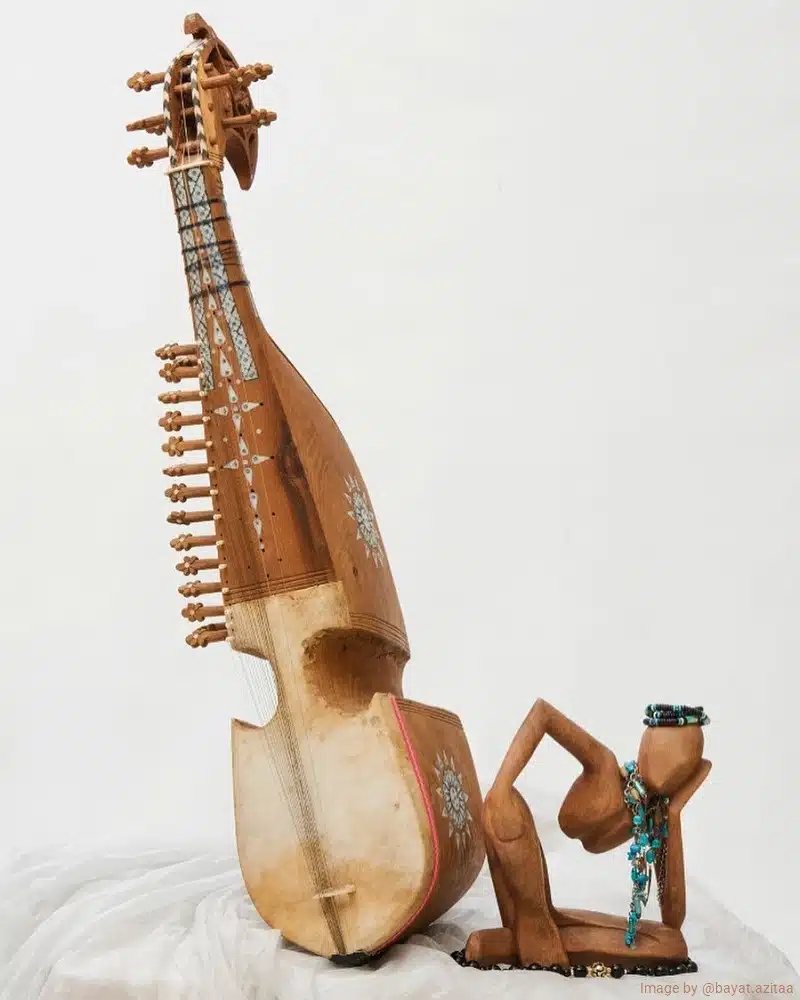
The body of the Rubab, like many traditional Iranian instruments, is made from seedless mulberry wood. The wood is hollowed out and covered with goatskin. In the past, the strings were made from sheep gut. Over time, however, changes were made to the instrument’s frets and strings, and nylon strings became more common because they are more durable and economical than traditional gut strings.
In general, the rubab consists of four main sections: the body, upper sound box, neck, and pegbox.
The lower body is a hollow, melon-shaped chamber covered with a thin but durable skin. A short bridge is placed on top of the skin.
The upper section of the rubab has a roughly triangular, box-like shape. Its outer edges are slightly rounded, giving it a fish-like appearance. This section is also made of wood. Along its sides is an element known as the haft-gushi, around which the instrument’s sympathetic strings are wound. The upper section is positioned toward the top of the instrument while it is being played.
On the lower side of the body, there is a circular sound opening. The neck is relatively short and usually carries around ten frets, or dastan.
The tuning pegs are located in the pegbox. There are three pegs on both the upper and lower sections of the pegbox, while the sides of the pegbox extend slightly toward the back.
The rubab generally has three or six strings arranged in pairs. Paired strings are tuned to the same pitch. The lowest string has a metal winding around its nylon core.
In summary, the main components of the rubab include the sound box, body, soundboard, neck, tuning pegs, nut, tailpiece, pegbox or crown, skin, bridge, frets, plectrum, and strings. The instrument may use different types of strings, including thin and thick gut strings as well as steel strings.
Types and Shapes of the Rubab
The rubab is generally made in three sizes, each producing a somewhat different tone:
- Large Rubab, or Shah Rubab
- Medium Rubab, or Rubab
- Small Rubab, or Zilcha
Rubab makers have also created the instrument in a variety of shapes. Some of the most common forms include:
- Rubab with a square-shaped body
- Rubab with a cylindrical body
- Rubab with a boat-shaped or kashkul body
- Rubab with a pear-shaped body
- Rubab with a spherical body resembling a kamancheh
- Rubab with a body resembling the modern setar or tanbur
- Rubab with an oval-shaped body
Differences Between the Balochi, Khuzestani, and Arabic Rubab
Balochi Rubab
The Balochi rubab is a bowed or plucked string instrument, depending on the local variety. It has a deep, rough-edged sound and is mainly used in the narrative and ritual music of Baluchistan. Its construction is generally simpler, with the emphasis placed on conveying storytelling, epic traditions, and collective sorrow rather than elaborate decoration.
Khuzestani Rubab
The Khuzestani rubab has generally been shaped by the influence of southern Iran’s Arabic musical traditions. Its sound tends to be warmer and softer. It is commonly used to accompany local singing, ritual music, and traditional performances, and its construction can be seen as lying somewhere between the Balochi and Arabic forms.
Arabic Rubab
The Arabic rubab has a much wider geographic distribution and appears in a variety of forms across Arab countries. Its sound is generally clearer and more melodic, and it plays an important role in classical and modal Arabic music. Its construction is often more refined, with more precise tuning than many of its regional Iranian counterparts.
Overall, the differences between these three forms of the rubab are not simply a matter of physical design. They are also rooted in their musical functions, cultural settings, and the traditions in which they developed.
The Art of Playing the Rubab
The rubab is a double-bodied, or double-chambered, instrument and, like the sitar, may have between 18 and 21 strings. Three or four of these are used for the melody and are considered the main strings. Another 17 or 18 strings serve to reinforce and enrich the instrument’s resonance; these are known as sympathetic or secondary strings.
When playing the rubab, the musician produces regular, rhythmic strokes on the secondary strings. The two resonating chambers of the rubab are positioned close together, giving the instrument a distinctive sound that differs from many other string instruments.
By comparison, instruments such as the sitar and subahar have separate resonating chambers positioned farther apart.
In the si-tar, the smaller resonating chamber has been removed. In the subahar, the resonating chamber is positioned at the back of the instrument.
Instruments such as the barbat, oud, sorud, small rubab, and other instruments whose names end in tar are generally classified among plucked string instruments. Each has its own distinctive playing techniques and tonal characteristics.
From a broader cultural perspective, the musical traditions of India, Iran, and Turan—particularly Khorasan—can be regarded as closely related. Just as these regions share similarities in rituals, celebrations, food, and clothing, their traditions of making and playing the Rubab also show many points of connection. The Rubab is one of the clearest examples of this shared musical heritage.
Famous Rubab Players
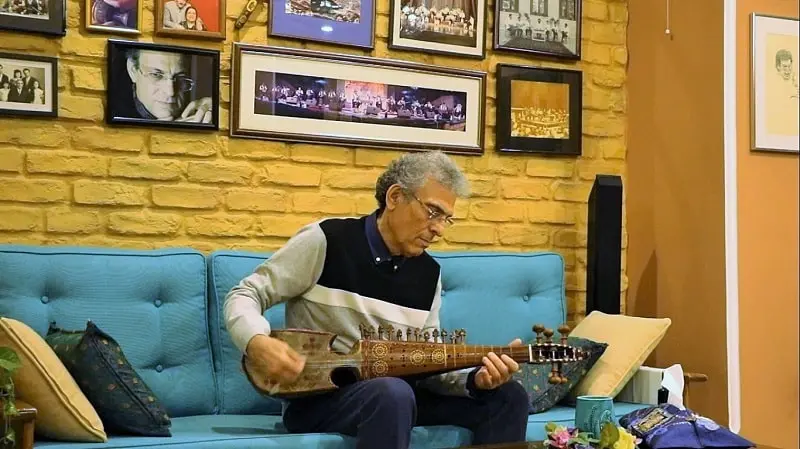
Among well-known rubab players, Rahim Khushnawaz is particularly associated with Afghanistan, while Bijan Kamkar is one of the prominent Iranian musicians known for playing the instrument.
Frequently Asked Questions about Rubab
If you couldn’t find the answer to your question here, leave us a comment in the comment section of this post, and we’ll get back to you as soon as possible.
How Is the Rubab Different from Other String Instruments?
The rubab is generally made from wood, skin, and other natural materials and has a warm, distinctive tone. Its playing technique, including the way the bow is held and drawn across the strings, differs from instruments such as the ghichak and kamancheh. Particular emphasis is placed on the movement of the bow and the natural resonance produced by the instrument’s skin-covered body.
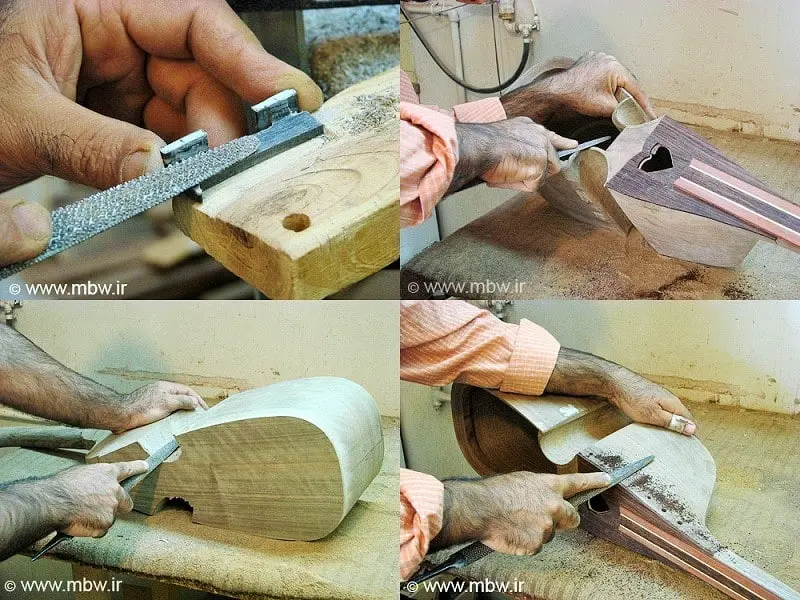
How Is a Rubab Made?
Making a rubab involves several carefully coordinated stages:
- Designing and carving the wooden body
- Covering the body with high-quality skin
- Attaching the neck and pegbox using durable materials such as bone or hardwood
- Installing and tuning the strings and adjusting the instrument’s resonance
For a high-quality instrument, it is best to have the rubab made by an experienced instrument maker.
What Styles of Music Are Performed on the Rubab?
The rubab is used in a variety of regional and modal musical traditions, including:
- Khorasan music
- Kerman music
- Kurdish music
It is played both in rural gatherings and formal performances, accompanying traditional regional songs and melodies.
How Can You Learn to Play the Rubab?
To learn the rubab:
- Study with experienced musicians who are familiar with its regional playing traditions.
- Practice consistently to develop control over playing techniques and tuning.
- Listen to and study older recordings to gain a better understanding of traditional regional styles and phrasing.